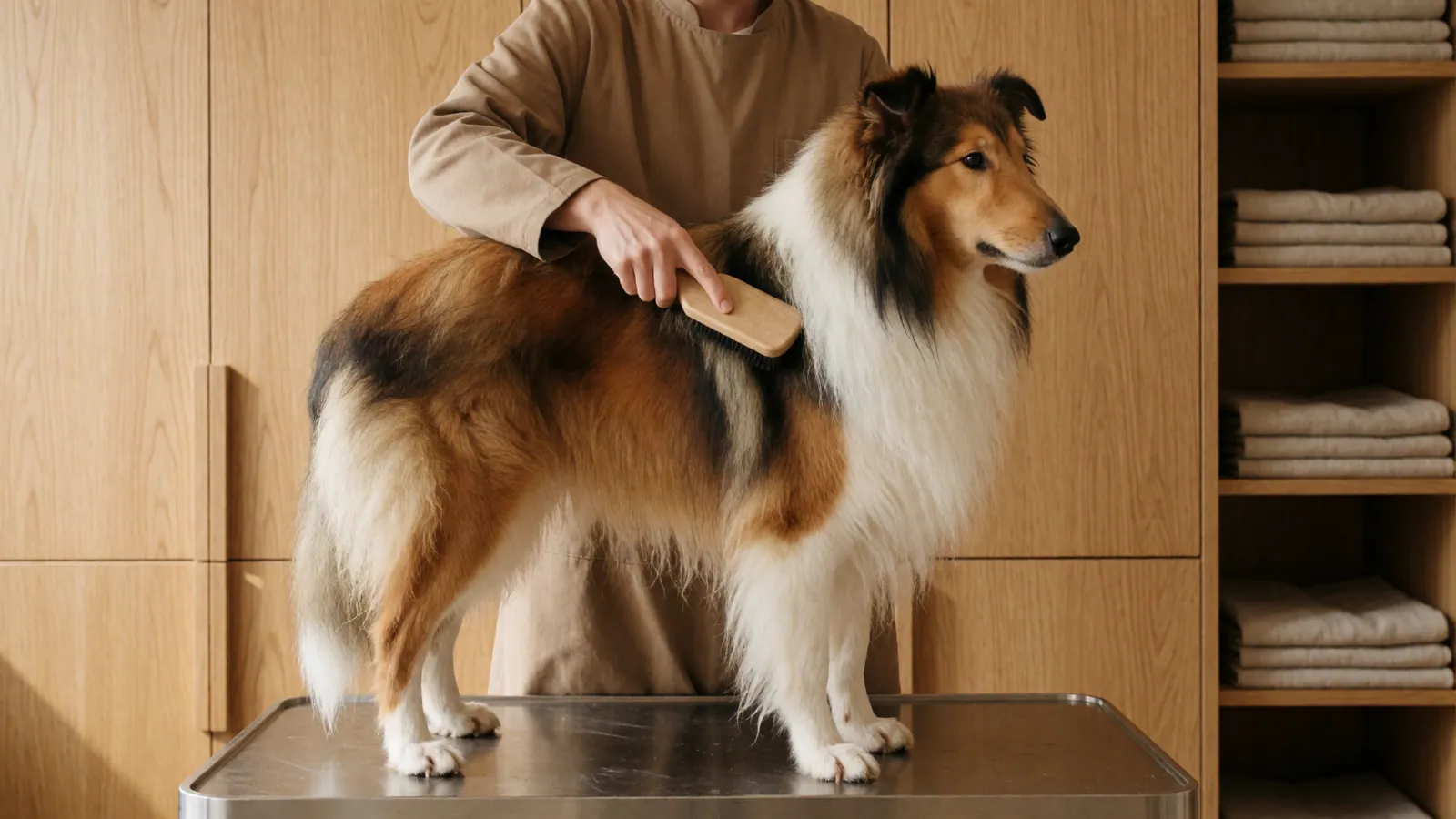
At a glance
Seven coats, seven intervals
Breed tells you a little. The coat in front of us tells you everything, and a mixed breed routinely carries two.
Curly and wool coats
Every 4–6 weeks.
Wire coats
Every 6–10 weeks.
Silky and long coats
Every 4–8 weeks.
Double coats
Every 8–12 weeks, more in spring and autumn.
Short and smooth coats
Every 8–12 weeks.
Cats
Long-haired: every 6–8 weeks. Short-haired: as needed.
Rabbits and guinea pigs
Long-haired: every 4–6 weeks.
Work it out for your dog
How to find your own dog's interval
Five minutes with a comb tells you more than the breed name ever will.
Look at the coat, not the breed on the papers
Coat type decides the interval far more than breed does, and a mixed breed routinely carries two coat types on one dog. If you are not sure which of the categories on this page your dog actually has, bring it in and we will tell you for nothing.
Notice how it behaves between visits
A coat that starts matting behind the ears or under the collar within a couple of weeks of a groom needs a shorter interval than the same breed whose coat still combs through cleanly at six weeks.
Match it to the closest band above
Curly and wool coats run four to six weeks, silky and long coats four to eight, wire coats six to ten, and double and smooth coats eight to twelve. Find the closest description rather than the exact breed name.
Adjust for the season
Spring and the weeks before a holiday fill the book fastest, for reasons that have nothing to do with the coat itself. Book slightly ahead of the interval at those times of year rather than exactly on it.
Book the next visit before the coat needs rescuing
The single biggest reason a groom is difficult is that the last one was months rather than weeks ago. If in doubt, book earlier than the interval suggests rather than later.
Every 4–6 weeks
Curly and wool coats
This is the coat that mats fastest and the one people most often underestimate. It does not shed, which is the whole appeal, but hair that does not fall out has to go somewhere — and where it goes is into a mat against the skin. Six weeks is the outside limit for anything kept longer than an inch.
- Typical breeds and types: Poodles, doodles of every kind, bichons, portuguese water dogs, bedlingtons.
- Between visits at home: Comb to the skin every day if the coat is long, every other day if it is short. A brush that only touches the top is why a coat that looks fine turns out to be solid underneath.
Every 6–10 weeks
Wire coats
Hand-stripped coats run on a longer, slower cycle and want to be rolled rather than reset all at once. Clipped wire coats need doing more often and will gradually go soft and pale, which is a real trade-off rather than a myth.
- Typical breeds and types: Schnauzers, most terriers, wire dachshunds, brussels griffons, airedales.
- Between visits at home: A weekly going-over with a slicker and a comb through the furnishings — the beard, the legs and the belly, which are soft and mat while the jacket does not.
Every 4–8 weeks
Silky and long coats
The length you want decides the interval far more than the breed does. A shih tzu in a short puppy trim is an easy dog on an eight-week cycle; the same dog in full coat is a daily commitment and a four-week groom.
- Typical breeds and types: Yorkies, maltese, shih tzus, afghans, long-coated chihuahuas, papillons.
- Between visits at home: Daily combing if you are keeping length, especially behind the ears and under the front legs. Kept short, twice a week is plenty.
Every 8–12 weeks, more in spring and autumn
Double coats
These coats are not shaved here except on a veterinarian's advice, and we will tell you why at the desk: the double coat insulates against heat as well as cold, and clipping it can change how it grows back for good. What they need instead is the undercoat properly out, which is what a de-shedding treatment is.
- Typical breeds and types: Huskies, german shepherds, golden retrievers, corgis, bernese, akitas, chows.
- Between visits at home: A rake through the undercoat once a week, and every day during a moult. You will be amazed and slightly appalled by how much comes out.
Every 8–12 weeks
Short and smooth coats
The grooming that matters on a smooth coat is not the coat at all — it is nails, ears, teeth and skin folds. A pug's face folds and a bulldog's tail pocket need attention on a schedule; the hair itself mostly looks after itself.
- Typical breeds and types: Labradors, beagles, boxers, pugs, staffies, dalmatians, whippets.
- Between visits at home: A rubber curry brush once a week does almost everything. These coats need bathing far less often than people think.
Long-haired: every 6–8 weeks. Short-haired: as needed
Cats
A cat that suddenly stops grooming itself is telling you something, and the something is usually pain, weight or age rather than laziness. That is a conversation for your veterinarian first and for us afterwards.
- Typical breeds and types: Persians, maine coons, ragdolls, norwegian forest cats, and any cat who has stopped grooming itself.
- Between visits at home: Comb a long-haired cat every day, in short sessions, starting when it is a kitten. A cat who has never been combed at six months is a very different proposition at six years.
Long-haired: every 4–6 weeks
Rabbits and guinea pigs
Rabbits are not bathed here, and should not be bathed at home either — the stress of it is genuinely dangerous to them. What they need is combing, nails and somebody who knows how to hold them without frightening them.
- Typical breeds and types: Angoras, lionheads, peruvian and sheltie guinea pigs.
- Between visits at home: Gentle daily combing during a moult, when the coat comes out in sheets. Short-coated rabbits mostly need nothing but nails.
Read this part
These are defaults, not a rule for your particular dog
Every interval above is the honest average for a coat in good condition being maintained at home between visits. Stretch it and the appointment gets longer, harder and dearer, and eventually stops being a haircut and starts being a rescue. If you are not sure which of these your dog actually has — and mixed breeds routinely have two — bring it in and we will tell you for nothing.
If a visit gets missed
What happens when the interval slips
Every interval above assumes a coat that is brushed at home and groomed on schedule. Miss it by a little and the appointment simply takes longer. Miss it by a lot and it can turn into a different job entirely.
A few weeks late
The coat is heavier and takes longer to bathe and hand-dry, and the price reflects the extra time. Nothing about the animal or the haircut itself has to change.
A couple of months late
Mats start forming where the coat rubs — behind the ears, under the collar, in the armpits and behind the back legs. De-matting is billed at $25 per fifteen minutes and capped at thirty by policy, because past that point a comb is doing more harm than the mat was.
Matted tight to the skin
This is where the honest answer changes. A mat felted against the skin cannot be brushed out without real pain, whatever the price, and the kind option is a short clip and a fresh start rather than hours fighting a coat that has already lost. Read the full matting and shave-down policy before you decide anything you are unsure about.
Timing it right
The calendar matters as much as the coat
Three stretches of the year fill the book before the rest. The first warm week of spring brings every double-coated dog in the neighbourhood at once, because the undercoat lets go all at the same time. The fortnight before Thanksgiving and the fortnight before Christmas are taken weeks ahead by people who want a tidy dog in the photographs. And the week after the Fourth of July is quiet, because half the dogs in Queens are still recovering from the fireworks. Book the spring de-shed in March and the holiday groom in October, and you will get the slot you actually wanted.
- Book the spring de-shed in March, before the undercoat lets go all at once.
- Book the holiday groom in October, a few weeks ahead of when you need it.
- The week after the Fourth of July is quiet — a good time for a coat that has slipped behind.
Questions
Grooming schedule — the questions we are asked most
How often should I bring my dog in for grooming?
It depends on the coat rather than the breed. Curly and wool coats such as poodles and doodles want a groomer every four to six weeks, silky coats every four to eight, wire coats every six to ten, and double or smooth coats every eight to twelve. The full breakdown, including what to do at home between visits, is above.
My dog is a mixed breed. How do I know which schedule applies?
Feel for a comb passing all the way to the skin rather than going by the breed name — a mixed breed very often carries two coat textures on one dog. If you are not sure which category yours has become, bring it in and we will tell you for nothing.
What happens if I leave it longer than the recommended interval?
The appointment gets longer, harder and more expensive before it changes into a different job entirely. A coat left a few weeks past its interval just takes longer to dry; a coat left months past it can mat to the skin, at which point de-matting stops being kind and a short clip becomes the honest recommendation — see /matting-policy.html for exactly how we handle that.
Why do double coats need de-shedding rather than a haircut?
A double coat insulates against heat as well as cold, and we do not shave one here except on a veterinarian's advice, because clipping it can change how it grows back. What it needs instead is the loose undercoat properly removed, which is what a de-shedding treatment does — full breakdown on /deshedding-treatment.html.
Does the interval change with the seasons?
The coat itself does not change its clock, but the calendar does — the first warm week of spring brings in every double-coated dog at once as the undercoat lets go, and the fortnights before Thanksgiving and Christmas book up weeks ahead. Booking slightly early at those times gets you the slot you actually wanted.
Can I stretch the interval to save money?
You can, but it rarely saves anything in practice. A coat left longer takes more time to bathe, dry and brush out, and the price reflects that extra time — so a longer gap between visits usually costs about the same or more across a year, for a coat that spends more of that year matted or heavy.
How do I keep my dog's coat in good condition between visits?
It depends on the coat type, but the general rule holds everywhere: a comb that only touches the top of the coat is not brushing it out, whatever the top looks like. Each coat type above has its own home routine — daily combing for silky and curly coats, a weekly rake for double coats, and far less for smooth, short coats.
What if I do not know what coat type my dog has?
Bring your dog in and we will tell you at no charge. It is a two-minute look, and it is far more reliable than guessing from the breed name, particularly for a mixed breed or a doodle whose coat can be genuinely different from what the parent breeds would suggest.
Not sure which interval is yours
Bring the coat in and we will tell you
A two-minute look at the coat tells us more than a breed name ever could, and it costs you nothing. We will tell you the honest interval and book it if you want.