Is something actually wrong with your pet? Grooming is not the right answer to a medical problem. If your pet has a wound, a hot spot, an ear that smells or is painful, a lump, a limp, a rash that is spreading, is scratching itself raw, or is in any distress, see a veterinarian first and come to us afterwards. We will happily groom around a healing problem once a vet has seen it, and we will tell you honestly when we think something needs a veterinarian rather than a bath.
Rabbit grooming in Woodside, NY means combing, a nail trim and a coat check for $60 — it does not mean a bath, and it never will here. Rabbits are prey animals with a genuinely fragile stress response: being wet, confined and handled all at once can tip a rabbit into a state that is dangerous rather than merely unpleasant, in a way that simply does not apply to a dog or even most cats. We would rather tell you plainly that we will not do it than offer a service that puts your rabbit at risk to satisfy a request.
We would gently say the same about bathing a rabbit at home. It is one of the more common pieces of advice we end up giving in reverse — not how to do it better, but why not to do it at all, even with the gentlest intentions and the warmest water. If a rabbit's coat or skin looks genuinely wrong to you — wet, stained, sore, or smelling of anything other than rabbit — that is a question for a veterinarian rather than something either of us should try to wash away.
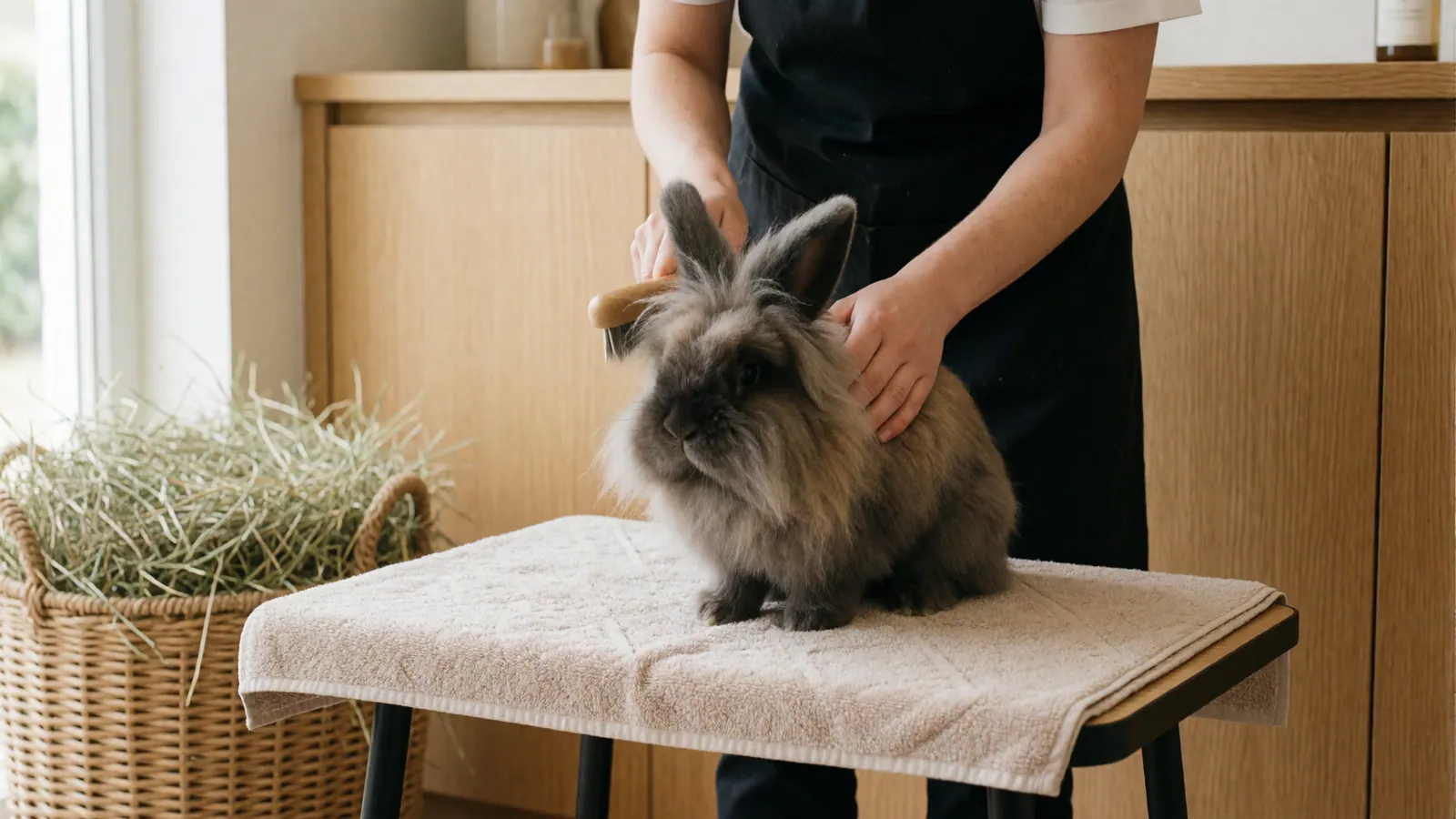
What we do instead is comb, in short sittings, often with your rabbit sitting on your own lap rather than a grooming table, because a lap is warm, familiar and considerably less frightening than a stainless surface under bright lights. Angoras and lionheads in particular moult in dense sheets rather than shedding gradually, and need a groomer on a regular rhythm through that period to stay ahead of it. Guinea pigs are handled the same unhurried way. See /grooming-schedule.html for how often your specific animal actually needs to come in, and /first-visit.html for what a first appointment looks like.
Why rabbits are never bathed here
This is a firm rule rather than a house preference, and we will not make an exception for a request, however reasonable it sounds.
A prey animal's stress response
A rabbit's whole system is built to respond to danger by freezing or bolting, and being held, wet and confined all at the same time reads to a rabbit's body as exactly that kind of danger, regardless of how gently it is actually done. That reaction can genuinely harm a rabbit — it is not simply a matter of the animal disliking the experience.
Why this is different from a cat or dog
Cats and dogs can be startled or unhappy about a bath without it being dangerous to them as a species, which is not equally true of a rabbit. We treat this as a different animal with a different risk profile rather than applying the same bathing routine to every species that comes through the door. That distinction is the whole reason this page exists as its own service rather than simply being folded into the cat page next to it.
What we do if a coat is genuinely dirty
Localised cleaning with a damp cloth on a specific soiled area, done briefly and without submerging the animal, is sometimes reasonable where a full bath is not. Even that is done conservatively, and if the mess or the smell suggests something medical rather than simply mess, we say so and point you at a veterinarian instead. We would rather leave a small mark than hold a rabbit still for longer than it can tolerate trying to get it perfectly clean.
Please do not bathe your rabbit at home either
We say this as plainly to owners as we say it about our own policy: the stress risk does not go away because the bath happens in your own kitchen sink with warm water and good intentions. If you are worried about odour, wetness or staining on your rabbit, a phone call to us or to your veterinarian is safer than a bath.
When wet or soiled fur is a veterinary question
A rabbit that is repeatedly wet around the tail, has a strong odour, or looks unwell alongside a dirty coat is not a grooming problem to be washed away — it is frequently a sign of something else going on that needs an actual examination. We tell you honestly when we think that is what we are seeing. We would rather send you to a veterinarian and be wrong than comb around something that genuinely needed looking at properly.
What a $60 visit actually involves
Combing, nails and a coat check, done at the rabbit's pace rather than the clock's.
Combing, section by section
A metal comb worked gently through the coat in small sections, checking for the beginnings of a mat before it becomes one, rather than one long pass over the top that misses what is happening underneath. Long-haired breeds need more time here than short-coated ones, and the visit is booked accordingly, without a rushed finish either way. We work from the head back, the same order every time, so a returning rabbit is combed the same predictable way it was last visit.
Nails
Trimmed with a small clipper sized for a rabbit's nail, which is thinner and more translucent than a cat's or dog's, making the quick easier to see and avoid in most rabbits. One person holds while another clips wherever a rabbit is particularly wriggly, so nobody is rushed into making a nick. Rabbit nails also grow continuously and can curl back into the pad if they are left too long, which is one of the more common reasons an owner books this visit in the first place.
A coat and skin check
Run through by hand and eye while combing, looking at the skin underneath rather than just the coat on top — for soreness, flaking, parasites or anything that looks different from last time. Anything found gets pointed out and, if it looks medical, pointed at a veterinarian rather than treated here. This is often the part of the visit that actually catches something, well before it would ever become visible from the outside of a full coat.
Angoras and lionheads in moult
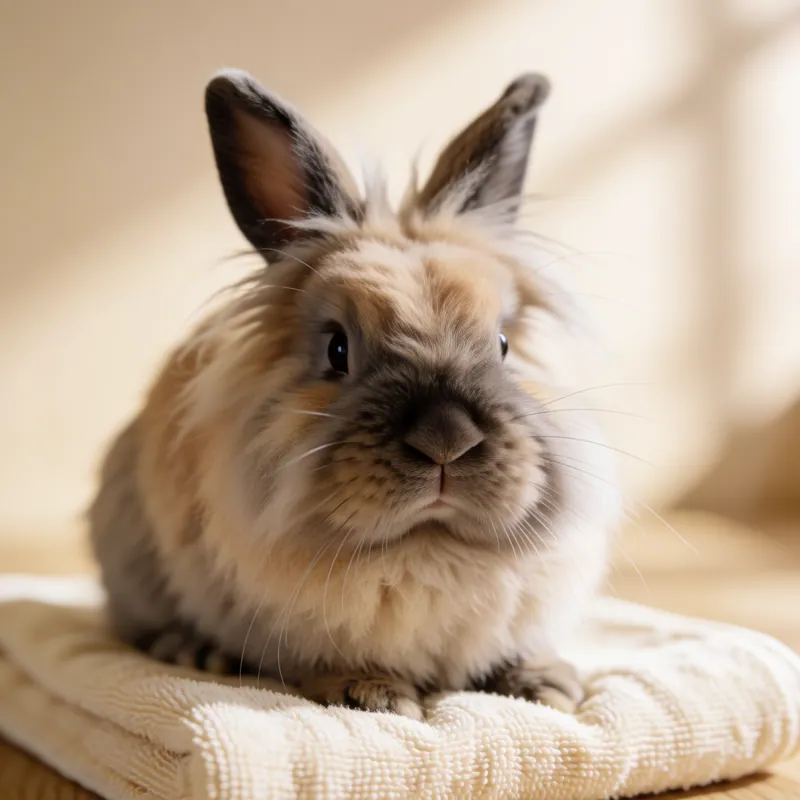
These breeds shed in dense sheets rather than gradually, and a rabbit in full moult can lose what looks like half its coat over a couple of weeks. Regular visits through that period — every four to six weeks — keep the shedding coat from matting against the new growth underneath it. Left too long between visits during a heavy moult, the loose coat packs down against the new growth and turns into exactly the kind of matting a comb can no longer manage.
Guinea pigs, on the same terms
Guinea pigs are combed, checked and have their nails trimmed the same unhurried way, at $60, with the same no-bath rule and the same short sittings. Long-haired guinea pigs, such as peruvians, need the coat checked more often than short-coated breeds do. A guinea pig's coat also collects bedding material at the belly and around the back end in a way a rabbit's does not, which is one of the first things we check and clear on every visit, gently and without turning the animal onto its back for longer than it tolerates.
Handling a prey animal without frightening it
Confidence and calm matter more here than speed, for a species that reads hesitation and restraint as danger.
Your lap is a legitimate grooming table
A rabbit is very often calmer sitting on its owner's lap, wrapped in a towel it recognises the smell of, than on a stainless table under bright lights among unfamiliar smells. We are glad to work this way whenever it suits the animal better, and it costs nothing extra to do it. Some of our most difficult rabbits to comb on a table have turned out to be perfectly easy once the whole visit simply moved to somebody's knee instead.
Short sittings rather than one long session
Combing is done in short stretches with breaks in between rather than one continuous session, because a rabbit's tolerance for being handled is genuinely shorter than a cat's or a dog's. Two ten-minute sittings usually achieve more, and cause less stress, than one twenty-minute session pushed straight through. We would rather book a second short visit later in the week than hold a tiring rabbit still to finish everything in one go.
How a rabbit is actually held
Supported fully under the body and hindquarters at all times, never lifted or restrained by the ears or the scruff alone, because a rabbit that feels unsupported can kick out hard enough to injure its own spine. Confident, gentle support is what keeps a rabbit calm, not a tight grip. This is worth mentioning specifically because it is exactly where handling advice sometimes gets it wrong, and getting it wrong can genuinely hurt a rabbit rather than merely upset it.
Reading a frightened rabbit
Thumping a back foot, flattening against the surface, or trying repeatedly to bolt are all signs a rabbit has had enough, and we stop and let it settle rather than pushing through those signals to finish sooner. A calm rabbit at the end of a visit matters more than a completed job. We would rather send you home with a rabbit that trusts us a little more than one that is simply finished for today.
Bringing your own carrier or blanket
A rabbit groomed on a blanket or towel from its own home, with a familiar smell on it, is generally calmer than one handled on a clean, unfamiliar surface. You are welcome to bring one, and we keep clean towels on hand for anyone who forgets or does not have one yet. It is a small, free thing that genuinely changes how a nervous rabbit behaves for the whole visit, and we will always ask if you have one before starting.
Rabbits & small pets in western Queens
Combing, nails and a coat check for rabbits and guinea pigs, done in short sittings — often on your lap rather than a table — with no bath, because bathing a rabbit is genuinely dangerous to it.
It starts the same way whatever you have booked: both hands over the whole animal before anything is switched on, so we find what is under the top layer rather than discover it halfway through. Then you are told the price and the finish time out loud, before you leave the building. If the coat turns out to be worse than it looked, we stop and call you, and you decide what happens next rather than finding out at collection.
Grooming is not veterinary care. Grooming is grooming, not veterinary care. This page describes a service we offer. It is general information, and it is not a diagnosis, a treatment or veterinary advice for any particular animal. We are groomers, not veterinarians — we do not diagnose, we do not prescribe and we do not treat medical conditions. If your pet has a wound, a lump, an ear or skin problem, a limp or anything that worries you, speak to a licensed veterinarian who can actually examine it.
How we handle your animal. We do not sedate animals and we never will — sedation is a veterinary decision made by a veterinarian, not a grooming shortcut. We use no heated cage dryers of any kind, and no animal is ever left alone with a dryer running. Every pet is hand-dried by the person grooming it. If your animal tells us clearly that it has had enough, we stop, and you get an honest conversation instead of a finished haircut.
Questions
Rabbits & small pets — the questions we are asked most
Do you bathe rabbits?
No, and we would encourage you not to at home either. A rabbit's stress response to being wet, confined and handled all at once is genuinely dangerous to it in a way that does not apply in the same way to a cat or a dog, and we are not willing to take that risk to satisfy a request. If your rabbit's coat or skin looks wrong to you, that is a question for a veterinarian rather than something to wash away.
What does a $60 rabbit visit actually include?
Combing worked through the coat in sections, a nail trim, and a coat and skin check, all done at your rabbit's pace rather than against the clock. Guinea pigs are seen on the same terms and the same price. There is no bath at any point, and we tell you honestly if we think something we see needs a veterinarian rather than a groomer.
My rabbit is moulting heavily — is that normal?
For an angora or a lionhead, yes — these breeds shed in dense sheets rather than gradually, and it can look alarming even when nothing is wrong. Regular combing every four to six weeks through a moult keeps the old coat from matting against the new growth underneath it. If the skin underneath looks sore, bald in patches, or your rabbit seems otherwise unwell, that is worth a call to your veterinarian alongside a grooming visit.
Will my rabbit be held on a table, or can I hold her myself?
Whichever your rabbit is calmer with — a lap wrapped in a towel she recognises is often less frightening for a rabbit than a stainless table under bright lights, and we are glad to work that way at no extra cost. What matters to us is that she stays calm through the visit, not which surface we happen to use to get there.
Do you trim rabbit nails, and is it different from a cat's or dog's?
Yes, and it is a bit different — a rabbit's nail is thinner and more translucent than a cat's or dog's, which usually makes the quick easier to see, though a wriggly rabbit makes up for that. One person holds while another clips, working slowly rather than rushing to avoid a nick. Nails alone, with no other grooming, are $20.
Do you groom guinea pigs too?
Yes — combing, a nail trim and a coat check, for $60, the same unhurried way and on the same no-bath basis as a rabbit. Long-haired breeds like peruvians need their coats checked more often than short-coated guinea pigs, since a long coat close to the ground picks up bedding and mats faster than people expect.
My guinea pig is very nervous about being handled. Can you still see her?
Yes, and telling us in advance helps us plan for it. Nervous small pets get short sittings with breaks rather than one long session, and we watch for the clear signs that an animal has had enough — thumping, flattening, repeated attempts to get away — and stop rather than push through them. A calmer visit that takes two short sittings is a better outcome than one that finishes fast and badly.
Is there a bath option if my rabbit really needs cleaning up?
No — this is one of the few things we will not do regardless of how the coat looks, because the stress risk to a rabbit is real rather than theoretical. What we can do is a localised clean of a specific soiled area with a damp cloth, done briefly, and we tell you plainly if what we are seeing looks like a question for a veterinarian rather than a grooming one.
Related
Usually booked alongside this
Cat & Small Pet
Cat grooming
A full cat groom — bath, hand-dry, comb-out and nails — in a separate quiet room with its own door, booked at roughly twice the length the job needs, with no sedation, ever.
Read more
Cat & Small Pet
Cat lion cut
The full clip for a long-haired cat whose coat has gone past what combing can manage, done slowly on skin that nicks easily, with the reasons behind it pointed at a veterinarian rather than guessed at here.
Read more
Cat & Small Pet
Senior & special needs
Grooming for senior and special-needs animals: low tables dropped to the floor, appointments split across two visits where that helps, frequent breaks, and no extra charge for any of the extra time it takes.
Read moreA price agreed before the clippers come out
Book an appointment
Call the salon with your pet's breed, weight and roughly when it was last groomed, and we will give you the price and the honest timing on the phone. Nails, ears and sanitary tidies are walk-in whenever we are quiet, and Saturday morning is a dedicated walk-in nail clinic.