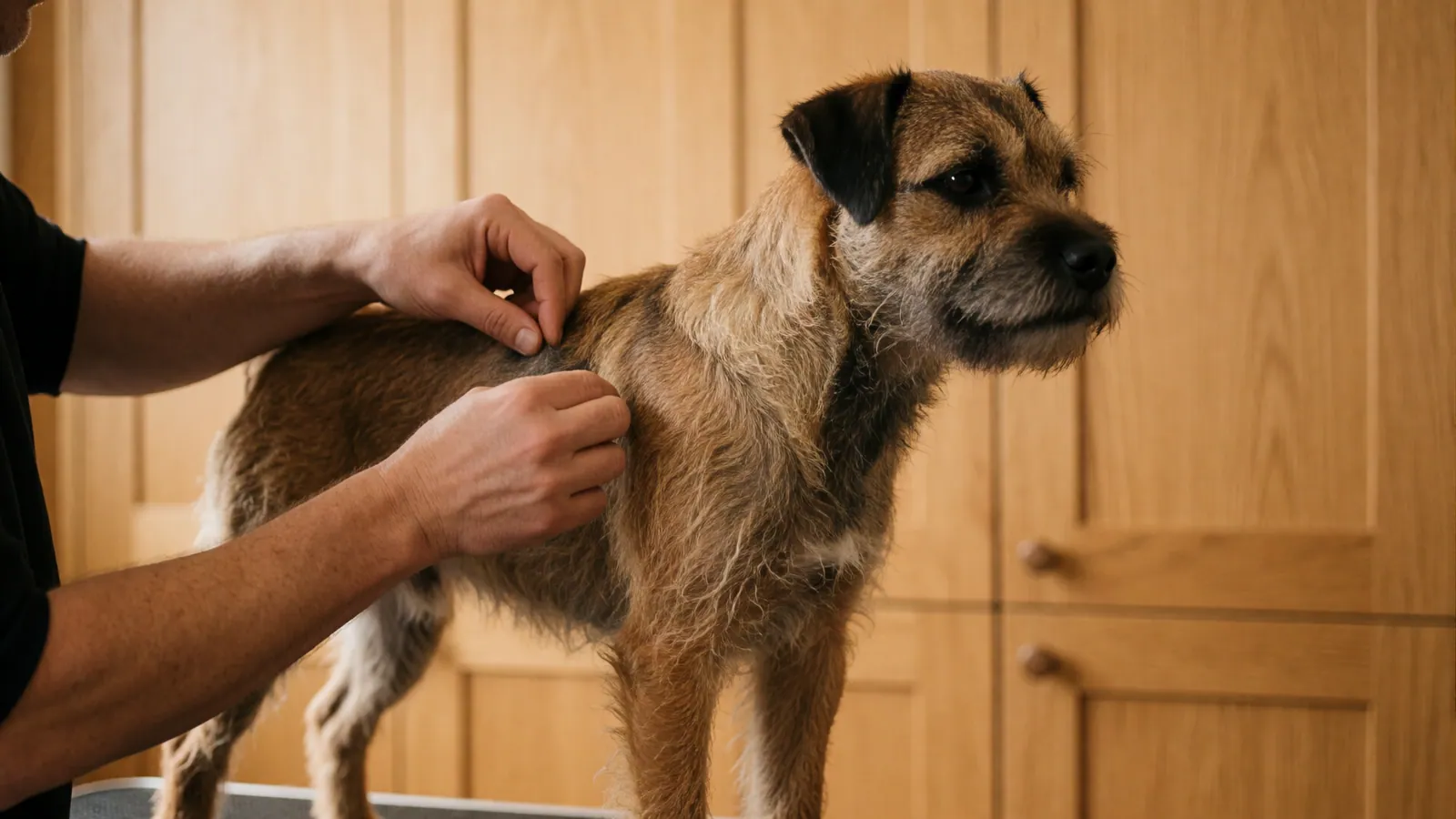
Is something actually wrong with your pet? Grooming is not the right answer to a medical problem. If your pet has a wound, a hot spot, an ear that smells or is painful, a lump, a limp, a rash that is spreading, is scratching itself raw, or is in any distress, see a veterinarian first and come to us afterwards. We will happily groom around a healing problem once a vet has seen it, and we will tell you honestly when we think something needs a veterinarian rather than a bath.
Hand-stripping is the traditional way a wire coat is groomed: dead hair pulled out by hand or with a fine stripping knife, working with the coat's own natural shedding cycle rather than against it with a clipper. It suits schnauzers, most wire-haired terriers, wire dachshunds, brussels griffons and airedales — breeds whose coat is actually built in two layers, a harsh wire top coat and a softer undercoat, and stripping removes the dead top layer without disturbing new growth coming in underneath it. See /breed-guide.html for which coats actually suit this technique.
There are two ways to go about it. Rolling a coat means stripping a little at a time on a regular schedule, so the coat is always at a fairly even length and never looks freshly done or overdue. Resetting a coat means stripping it all the way down at once and letting it regrow together from the same starting point, which is more dramatic and usually chosen before a specific date rather than as an ongoing routine. We will talk through which suits your dog and your patience before booking either one.
This is slow, hands-on work — considerably slower than running a clipper over the same dog — which is why it is priced by time rather than by a flat fee, starting from $150 for a shorter session and running longer for a full strip on a larger or more overdue coat. It is also not automatically the right choice for every wire-coated dog: an older dog, one with sensitive skin, or one who simply finds the sensation uncomfortable is very often better served by clipping, and we will tell you honestly when we think that is the case for yours.
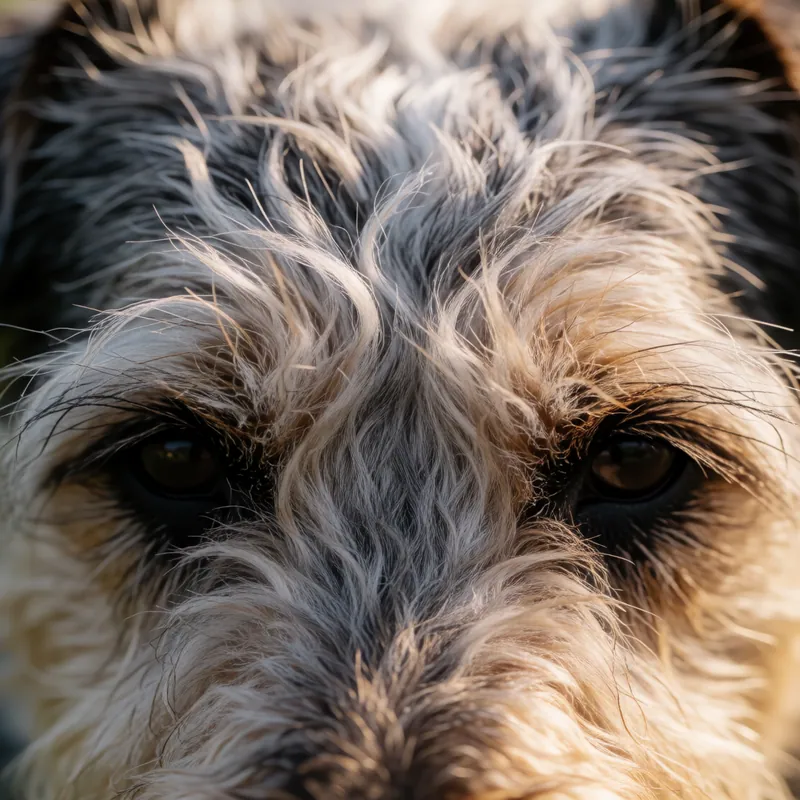
Rolling a coat and resetting a coat
Two different rhythms for the same technique, chosen for different reasons.
Rolling
A little coat stripped at each visit on a regular cycle, so the coat is never let all the way down and never looks freshly stripped either — it stays at a fairly consistent length and texture year-round. This is the more common approach for a dog shown regularly or simply kept looking the same all the time, and it needs a visit roughly every few weeks rather than every few months.
Resetting
The whole coat stripped down at once, usually chosen ahead of a specific date or season rather than as an ongoing routine, and followed by a longer stretch of regrowth before the next full strip. It is more dramatic in a single visit and asks less of the calendar in between, at the cost of the coat looking genuinely bare for a week or two afterward.
Which one we recommend, and when
Rolling suits an owner who wants a consistent look and does not mind more frequent, shorter visits. Resetting suits an owner happy to plan around one longer appointment and a bare-looking fortnight afterward. Neither is more correct than the other — it is a genuine preference, and we will explain what each will actually look like on your specific dog before you choose.
How long a full strip actually takes
Anywhere from ninety minutes for a small terrier kept on a regular rolling schedule to several hours for a large, overdue schnauzer being reset all at once, depending on the size of the dog and how much coat there actually is to remove. This is exactly why it is priced by time rather than as a flat fee. The furnishings — the beard, legs and eyebrows — are typically finished separately with scissors once the jacket itself has been stripped.
What happens between appointments
A weekly going-over at home with a slicker brush and a comb through the furnishings — the beard, the legs and the belly — keeps the coat manageable between visits, since those softer areas mat while the stripped jacket itself generally does not. We will show you the right brush and technique at the desk.
Why a stripped coat is not the same as a clipped one
The honest trade-off between the two, stated plainly rather than sold either way.
Colour
A hand-stripped wire coat generally keeps its true, saturated colour far longer than the same coat repeatedly clipped, because clipping cuts through pigmented guard hair at a point partway along its length rather than removing it at the root the way stripping does. A clipped wire coat visibly fades and softens in colour over a year or two; a stripped one holds it.
Texture
The harsh, wiry texture a schnauzer or terrier is meant to have comes from the guard hair growing out naturally to its full length and being removed at the root when it is ready to shed. Repeated clipping cuts across that hair partway and encourages the softer undercoat to dominate, which is why a clipped wire coat gradually feels more like plush than wire.
What clipping does to a wire coat over time
It is not damage exactly, and plenty of owners choose clipping anyway for entirely good reasons — cost, time, an older dog, a coat that has already softened. But the jacket will noticeably soften and pale over successive clips, losing the wiry snap it started with, and that change is not generally reversible by going back to stripping later on the same coat. It is honestly worth knowing before you choose a technique, not after several years of clipping.
Time and cost, honestly compared
Clipping a wire coat is faster and cheaper, priced the same as a full groom at $85 to $165 by size. Hand-stripping starts from $150 and takes considerably longer, because it is done by hand rather than machine. Neither price reflects one being a better groom than the other — they are different techniques with different results.
Both are legitimate choices
Plenty of perfectly happy wire-coated dogs are clipped their whole lives, and plenty are stripped their whole lives — the honest difference is in colour, texture and cost, not in which dog is groomed correctly. We will tell you what each will actually look like on your specific dog rather than push you toward the one that takes longer.
When clipping is honestly the better choice
Hand-stripping is not automatically the right answer for every wire-coated dog, and we will say so.
An older dog
Hand-stripping asks a dog to stand still for a genuinely long session, and an older dog with stiff joints or less patience for handling often does better with a quicker clip, even if it means trading away some of the texture and colour stripping would keep. Comfort matters more than tradition at that point, and we will say so plainly.
A dog with sensitive skin
Stripping is not painful when done properly and at the coat's own readiness, with hair coming away easily rather than being forced. But a dog with genuinely sensitive or reactive skin, or one prone to skin irritation generally, can find the repeated handling and the sensation itself more than they want to tolerate, and pushing through that anyway is not a trade we think is worth making for the sake of a coat's texture or colour.
A dog who is genuinely uncomfortable with it
Some dogs settle into hand-stripping without any fuss at all; others clearly do not, however patiently and gently it is done, and continuing anyway is not something we will do simply because a stripped coat is considered more correct for the breed. If your dog tells us plainly it has had enough, we stop and talk about clipping instead.
A coat that has already been clipped for years
Once a wire coat has been clipped repeatedly for a long stretch, the texture has usually already softened enough that stripping will not fully bring back the original harsh jacket, and starting to strip at that point is a much longer road than it would have been earlier. We will tell you honestly whether it is worth starting.
We will tell you honestly which applies to your dog
This is genuinely one of the more common conversations we have on the floor, and we would rather talk you into a clip that suits your actual dog than sell you a longer, pricier appointment that its temperament, age or skin cannot comfortably manage. Ask us directly and we will give you a straight answer.
Hand-stripping in western Queens
Hand-stripping for wire coats — schnauzers, terriers, wire dachshunds and similar breeds — pulling the dead coat by hand rather than clipping it, so it keeps its harsh texture and colour, slow work priced by time from $150.
It starts the same way whatever you have booked: both hands over the whole animal before anything is switched on, so we find what is under the top layer rather than discover it halfway through. Then you are told the price and the finish time out loud, before you leave the building. If the coat turns out to be worse than it looked, we stop and call you, and you decide what happens next rather than finding out at collection.
Grooming is not veterinary care. Grooming is grooming, not veterinary care. This page describes a service we offer. It is general information, and it is not a diagnosis, a treatment or veterinary advice for any particular animal. We are groomers, not veterinarians — we do not diagnose, we do not prescribe and we do not treat medical conditions. If your pet has a wound, a lump, an ear or skin problem, a limp or anything that worries you, speak to a licensed veterinarian who can actually examine it.
How we handle your animal. We do not sedate animals and we never will — sedation is a veterinary decision made by a veterinarian, not a grooming shortcut. We use no heated cage dryers of any kind, and no animal is ever left alone with a dryer running. Every pet is hand-dried by the person grooming it. If your animal tells us clearly that it has had enough, we stop, and you get an honest conversation instead of a finished haircut.
Questions
Hand-stripping — the questions we are asked most
What is hand-stripping, exactly?
It is dead coat pulled out by hand or with a fine stripping knife, working with a wire coat's own natural shedding cycle rather than cutting across it with clippers. It suits schnauzers, most wire-haired terriers, wire dachshunds, brussels griffons and airedales, whose jacket is actually built to be removed this way rather than clipped, and it is what keeps that coat's true colour and harsh texture over time.
Does hand-stripping hurt my dog?
Done properly, on coat that is actually ready to release, it is not painful — the hair comes away with comparatively little resistance at the right stage of its cycle, and most dogs settle into it without fuss. Some dogs genuinely do not tolerate it well however carefully it is done, and if yours is one of them, we stop and talk about clipping instead rather than push through.
How much does hand-stripping cost?
It starts from $150 and runs higher for a larger dog or a full strip on an overdue coat, because it is priced by time rather than as a flat fee — hand-stripping a large, neglected jacket can take several hours of genuinely hands-on work. We will give you a real estimate once we have felt the coat, not a guess over the phone.
Why does hand-stripping cost more than a regular haircut?
Because it takes far longer. Clipping a wire coat runs the same $85 to $165 as any other full groom, priced by size; hand-stripping is done by hand rather than machine, sometimes over several hours, which is reflected in the from-$150 starting price. Neither is a better or worse groom — they simply take a different amount of skilled time.
My schnauzer has always been clipped. Can we switch to hand-stripping now?
Sometimes, though it depends how long the coat has been clipped for — a jacket clipped repeatedly for years has often already softened past the point where stripping brings back much of the original harsh texture. We will look at your dog's actual coat and tell you honestly whether starting to strip now is likely to make a real difference.
Is hand-stripping better for my dog than clipping?
Not automatically, no — it is different, not superior. It keeps the coat's colour and texture in a way clipping does not, but it is slower, costlier, and simply not comfortable for every dog, particularly an older one or one with sensitive skin. We will tell you plainly which we think suits your specific dog rather than assume stripping is always the right answer.
My dog is older and does not sit still as well as he used to. Should we still strip his coat?
Possibly not, honestly. Hand-stripping asks for a longer, steadier session than clipping does, and an older dog with stiff joints or less patience for handling very often does better with a quicker clip, even though it means the coat will gradually lose some of its texture and colour. Comfort matters more than tradition, and we will say so plainly at the coat check.
What is the difference between rolling and resetting a coat?
Rolling strips a little of the coat at each regular visit, keeping it at a fairly consistent length year-round. Resetting strips the whole coat down at once, usually ahead of a specific date, leaving it looking genuinely bare for a week or two before it grows back together. Neither is more correct — it is a real preference, and we will explain what each looks like on your dog before you choose.
Related
Usually booked alongside this
Dog Grooming
Full dog groom
The complete appointment for a dog who needs the works: a coat check, a bath, a full hand-dry, a haircut suited to the coat in front of us, nails, ears and a sanitary tidy, priced before anything starts.
Read more
Dog Grooming
Bath & brush
The no-haircut appointment for a dog who needs washing and untangling rather than clipping: two washes on most coats, a full hand-dry, a brush-out, nails, ears and a sanitary tidy.
Read more
Dog Grooming
Haircut & styling
Breed trims, pet trims and everything between: the right blade length or guard comb chosen for the coat, scissoring finished on a fully dry coat, and a length matched to whatever suited your dog last time.
Read moreA price agreed before the clippers come out
Book an appointment
Call the salon with your pet's breed, weight and roughly when it was last groomed, and we will give you the price and the honest timing on the phone. Nails, ears and sanitary tidies are walk-in whenever we are quiet, and Saturday morning is a dedicated walk-in nail clinic.